
Parking Lots Are One Of The Most Disputed Places To Have A Car Accident
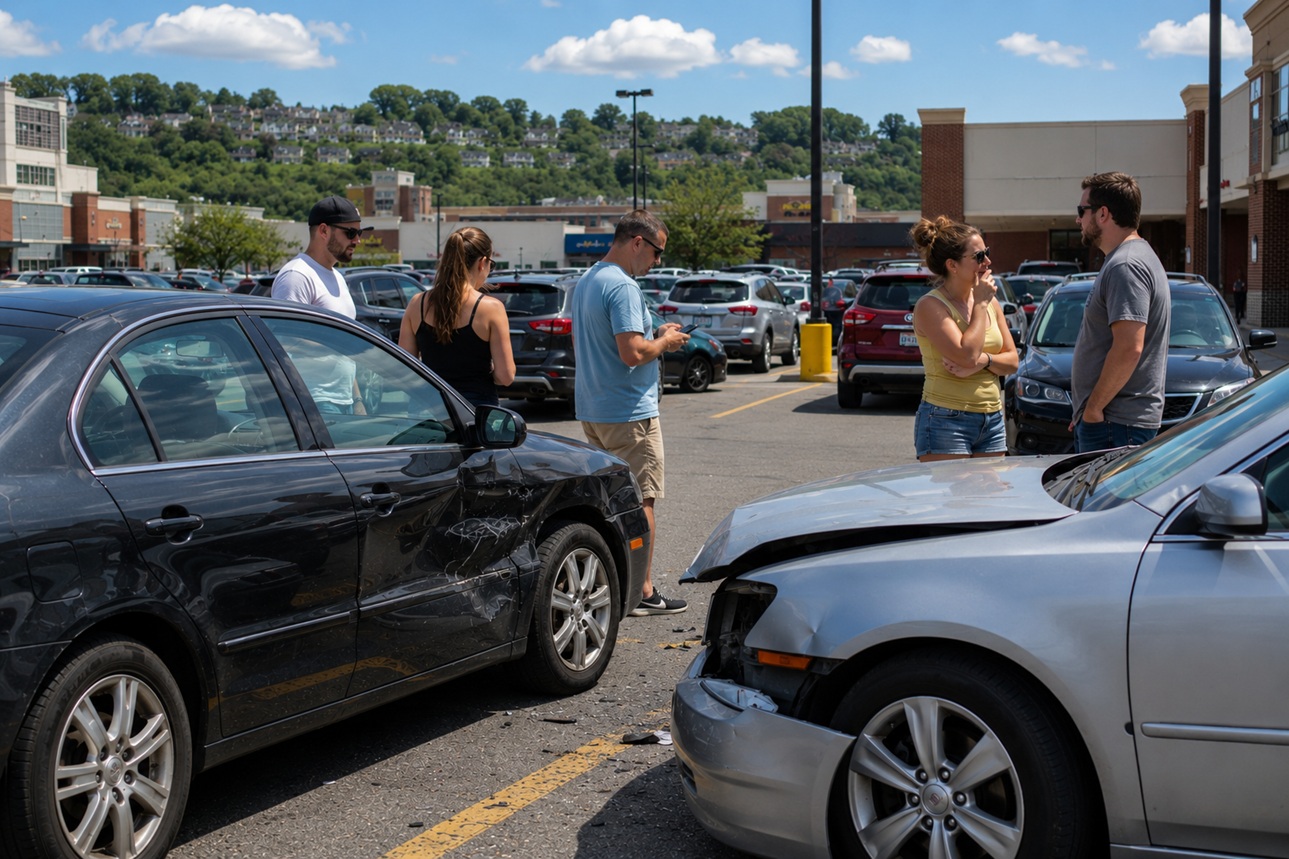
Parking Lot Accidents In Pittsburgh Often Come Down To Evidence And Fault
Pittsburgh’s parking lots, the sprawling lots off McKnight Road, the multilevel garages downtown, the crammed rows outside South Side shops on a Friday night, are designed for convenience, not safety. Lanes lack traffic signals. Drivers back out blindly. The unwritten rules of who has the right of way are often ambiguous. And when two drivers end up in the same space at the same time, both usually believe the other was at fault.
The numbers bear that out. According to the National Safety Council, tens of thousands of car accidents happen in parking lots and garage structures every year, resulting in more than 60,000 injuries and 500 deaths annually. Two-thirds of drivers admit they’re distracted when driving through parking lots, and one in five car accidents across the country happens in a parking lot or garage.
Our Pittsburgh car accident lawyers at Romanow Law Group regularly handle fault disputes in parking lot accidents. Insurance companies don’t resolve these cases quickly, and they don’t automatically believe you. Understanding why these crashes generate so many disputes and what evidence can prove what happened can make a major difference in the outcome of your claim.
Why Are Fault Disputes So Common After Parking Lot Accidents In Pennsylvania?
The core problem is that parking lots are legally and physically different from public roads. On public streets, traffic laws provide a clear framework: traffic signals, lane markings, posted speed limits, and rules of the road that every driver learns before getting a license. Parking lots, particularly private commercial lots, have almost no such infrastructure, and the few rules that do apply are poorly marked and routinely ignored.
On a public road, a driver who blows through a red light is clearly at fault. In a parking lot, two drivers approaching the same intersection from different feeder lanes at the same time often have equally plausible claims that the other didn’t yield. There’s no signal to cite, no official documentation of whose turn it was, and no officer who saw it happen. That ambiguity is why insurance adjusters push back hard on parking lot claims.
Police response adds another layer of difficulty. Because parking lots are typically private property, police don’t always respond to low-speed accidents there. When they do respond, they may not issue a crash report. Without a police report, you lose one of the most important pieces of documentation an insurance company accepts as an objective account of what happened.
That’s why knowing what to do after a Pittsburgh car accident matters even when the crash happens in a parking lot. The steps you take in the first few minutes can affect whether the claim becomes provable or turns into a contest between two competing stories.
What Types Of Parking Lot Accidents Happen Most Often In Pittsburgh?
Not all parking lot accidents carry the same fault analysis. The circumstances of the collision, which cars were moving, which were stopped, and who had the right of way in that particular lane, shape how liability is assigned. Some collision patterns create clearer liability than others, but even the “clear” ones get contested.
These are the collision types that cause the most disputes:
- Two Cars Backing Out Simultaneously: Both drivers were reversing at the same time, and neither saw the other. Fault is often split, and insurance companies use the shared-blame scenario to reduce both payouts.
- A Car Backing Out Strikes A Passing Vehicle: The driver backing out generally bears greater fault, but the passing driver’s speed is a contested issue. Adjusters argue the passing car was moving too fast for the conditions.
- A Driver Exits A Feeder Lane Without Yielding: Cars in the main thoroughfare lanes generally have the right of way over cars exiting a parking space or a secondary feeder lane. When a driver pulls out without looking, the crash pattern can resemble a T-bone accident, and injuries can be serious.
- Two Cars Competing For The Same Parking Space: Both drivers were moving toward the same open spot and collided as they approached. These disputes often come down to which vehicle had a clear positional advantage before the other entered the lane.
- A Moving Car Strikes A Pedestrian: Pedestrian accidents in parking lots are common and can be severe. The driver often carries significant fault, but lot owners can also be liable if poor lighting, obstructed sightlines, or unmarked pedestrian paths contributed.
The common thread across all scenarios is that neither driver expected the other to be there. Low speeds create false confidence, and the result is a collision where both sides have a story that makes sense from where they were sitting.
Who Has the Right-of-Way in a Parking Lot?
Pennsylvania doesn’t have a specific statute that governs right-of-way within parking lots the same way it governs right-of-way at intersections on public roads. The general principles of negligence apply: drivers must operate their vehicles with reasonable care under the circumstances, but the specific rules depend on where in the lot the collision occurred.
The layout of a parking lot creates a functional hierarchy. Main thoroughfare lanes, the wider lanes that run along the perimeter of a lot or serve as the primary routes in and out, usually carry the higher right of way. Feeder lanes, the narrower lanes that run between rows of parking spaces, are subordinate to the thoroughfares. Parking spaces themselves require drivers to yield to anyone traveling in the feeder lane before they can pull out safely.
In practice, a driver pulling out of a parking space is often considered at fault when they hit a car traveling through the feeder lane. A driver exiting a feeder lane into a main thoroughfare should yield to through traffic. And a driver who rear-ends a stopped car in any lane carries the same general fault presumption that applies in rear-end accidents on public roads. The further a driver departs from these basic patterns, the more complicated the fault analysis becomes.
How Does Pennsylvania’s Comparative Negligence Law Affect Your Claim?
Pennsylvania operates under a modified comparative negligence rule, codified in 42 Pa. C.S. § 7102. Under that rule, an injured driver can still recover compensation even if they were partly at fault for the accident, as long as their percentage of fault doesn’t exceed 50 percent. If it does, they’re barred from obtaining compensation. If it doesn’t, their damages are reduced in proportion to their share of fault.
Here’s what that looks like in practice. A driver backing out of a parking space at Giant Eagle on McKnight Road clips a car traveling through the feeder lane. The backing driver carries the majority of the fault, but the passing driver was traveling a bit fast for the conditions. A jury assigns 70 percent of the fault to the backing driver and 30 percent to the passing driver. If the injured driver’s damages total $100,000, they recover $70,000, their full damages minus their 30 percent share.
Insurance companies understand this framework very well. They use it aggressively. In parking-lot cases, where the facts are genuinely ambiguous, adjusters routinely argue that the injured driver was at least 51 percent at fault, thereby extinguishing any recovery. That’s not a good-faith assessment of the evidence. It’s a negotiating tactic.
Pennsylvania’s modified comparative fault rule can make or break an injury claim, especially when both drivers insist the other one caused the crash. The right attorney can document the facts and push back against inflated fault assignments before they stick.
Does It Matter That Parking Lots Are Private Property?
It does, and it matters more than most accident victims realize. On a public road, the government maintains the road, posts the signs, and sends police when there’s a crash. In a commercial parking lot, the lot owner is a private party with its own legal responsibilities. That distinction can open an additional line of liability when the lot’s condition contributed to the accident.
Under Pennsylvania premises liability law, property owners have a duty to maintain their lots in a reasonably safe condition. A lot with burned-out lights at night, faded lane markings, potholes that force drivers out of lanes, missing stop signs, or inadequate space for the volume of traffic it handles can create liability for the owner when those deficiencies contribute to a crash.
That means the lot owner’s insurance, not just the at-fault driver’s coverage, may be in play. A premises liability claim can be part of the case when unsafe property conditions contributed to the collision or made it more dangerous.
Identifying premises liability as a potential claim requires a different investigation than a standard car accident case. You’re looking at the lot’s maintenance records, its history of prior incidents, and the specific conditions at the time of your crash. That’s work that benefits from an attorney who knows where to look and how to preserve evidence before it disappears.
What Evidence Makes Or Breaks A Parking Lot Accident Claim?
Because police reports are often absent and the physical evidence of a low-speed collision can be limited, parking lot claims live or die on documentation. The difference between a strong claim and a dead-end dispute usually comes down to what evidence was collected at the scene and how quickly it was collected.
The most valuable evidence in a parking lot accident includes:
- Surveillance Camera Footage: Commercial parking lots often have security cameras, and that footage can capture the collision exactly as it happened. It’s also the first thing that gets overwritten, with many systems cycling footage within days. Surveillance camera footage can be powerful evidence in a car accident claim, but only if someone acts quickly enough to preserve it.
- Witness Statements: Shoppers, employees, and other drivers in the lot may have witnessed the collision or the moments leading up to it. Witnesses who aren’t involved in the accident tend to be credible to insurance companies and juries alike. Witnesses in Pennsylvania car accident cases can help clarify speed, direction, lane position, and what each driver did before the impact.
- Photographs Of The Scene: Photos of both vehicles, the lane markings, the sight lines, any obstructions, and the position of the cars immediately after impact can establish exactly where the collision occurred within the lot’s layout.
- Medical Records: Even a low-speed collision can produce serious car accident injuries, particularly to the neck and back. Getting evaluated immediately creates a record linking your injuries to the accident before the other side can argue they occurred elsewhere.
- The Lot’s Condition At The Time: Note anything about lighting, pavement condition, lane marking visibility, or signs. If the lot’s physical state contributed to the accident, that evidence is perishable. Potholes get patched, lights get fixed, and lines get repainted.
A Pittsburgh car accident attorney can quickly begin preserving evidence, which is often the difference between a provable case and a credibility contest where the insurance company holds most of the cards.
Why Insurance Companies Push Back On Parking Lot Claims
Parking lot accident claims give insurance companies room to argue. They may claim that both drivers were equally responsible, that the crash was too minor to cause serious injuries, that the lot owner had no responsibility, or that the injured person waited too long to get medical treatment. When there’s no police report or video footage, those arguments can gain traction quickly.
Insurance adjusters may also ask for a recorded statement early in the claim, before the injured person understands the full extent of their injuries or how fault is being disputed. Before agreeing to speak on the record, it’s important to understand how recorded statements after a car accident can be used to reduce or deny a claim.
The value of a parking lot accident claim depends on fault, injuries, medical treatment, lost income, future limitations, and available insurance coverage. When adjusters try to minimize a claim because the crash occurred at low speed, an attorney can focus the case on the actual harm caused, not the setting in which it occurred.
How Can A Pittsburgh Car Accident Attorney Help You?
Parking lot accidents look simple from the outside. Two cars at low speed, minimal damage, everyone walks away. But when insurance companies start assigning fault, and they will assign fault in ways that benefit their bottom line, not yours, the case gets complicated fast. Disputed facts, missing police reports, private property issues, and Pennsylvania’s comparative negligence rules can combine to reduce or eliminate a claim that should have been straightforward.
Our Pittsburgh car accident attorneys at Romanow Law Group investigate from the scene outward. We identify and preserve surveillance footage before it’s overwritten. We locate witnesses and document the lot’s condition. We evaluate whether the property owner carries any share of the liability. We handle negotiations with the insurance company so you’re not navigating a claim alone as you recover.
There are no upfront costs and no legal fees unless we win your case. Call 1-844-GET-MORE or contact us online to schedule a free consultation with one of our Pittsburgh car accident lawyers.
“David and his Associates are amazing…I would recommend them to anyone, they had my case settled in under 6 months and kept good communication with me the whole time…very professional and passionate about what they do.” – Anthony H., ⭐⭐⭐⭐⭐